The Guardian
Connecting Thin Black Lines
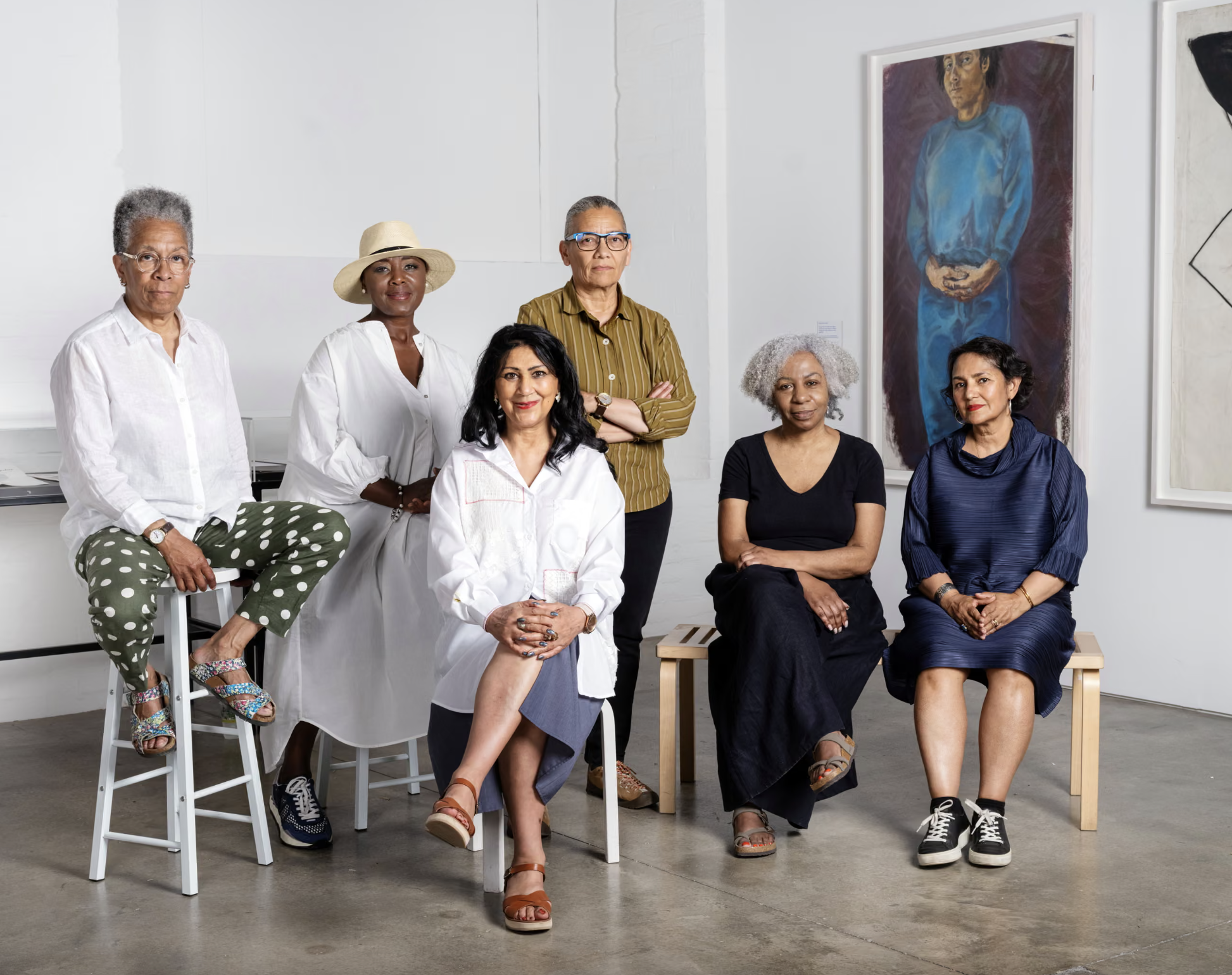
In 1985, a groundbreaking show curated by Lubaina Himid tore down barriers – and appalled critics. As a new exhibition revisits that pivotal moment, the artists remember the prejudice they faced – and what they have achieved since
It is November 1985 and in a corridor of London’s ICA, a pivotal moment in British art history is about to take place. Curated by Lubaina Himid, The Thin Black Line displays work by 11 Black and Asian women artists, hung on the walls of the museum’s narrow walkway – to signify just how they’ve been marginalised. Their work – which explores social, cultural, political, feminist and aesthetic issues – comes as a shock to the stuffy art establishment.
Critics dismiss it, or deride the works as “angry”. And yet this show, placing Black women artists firmly at the centre of contemporary British art history, will come to be seen as a turning point, paving the way for future winners of the Turner prize (Himid and Veronica Ryan) and Venice Golden Lion (Sonia Boyce).
Forty years on, the ICA is revisiting the show with Connecting Thin Black Lines 1985–2025, building on its legacy with new and old works from the original artists, and new contributors. Here, some of them reflect on the original exhibition, the reaction it received, and how the art world has changed.
Sutapa Biswas: The 1980s were a charged time politically, socially and economically. I arrived at art college in 1981 with a great degree of understanding about the histories of the empire and how it impacted my parents. They were born in what was called British India. They experienced partition and genocide and were displaced. It was a complex time in the UK, too. In my community in west London, the Southall Youth Movement, an antiracist group, had burned down the Hambrough Tavern where skinhead bands played.
Marlene Smith: I was a student, studying for my BA at Bradford School of Art. By the time I joined the BLK Art Group, an association of young Black artists, I was already thinking about my identity in relation to feminism. I was not the only Black person studying, but I was one of few. I was certainly the only person trying to make work with political overtones.
Jennifer Comrie: I was living through a really interesting time: the Troubles, the miners’ strike, Thatcherism, apartheid in South Africa. My work reflected this. Art for me has always been a way to garner a better understanding of myself and the world around me.